From the Editor's Desk: A new growth trajectory for the HGS Bulletin
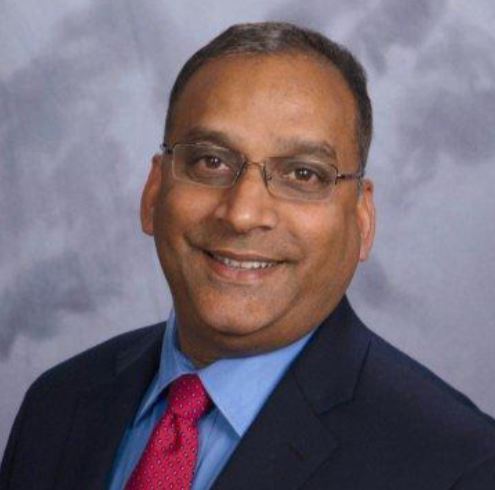
Sharma Dronamraju, Editor, HGS Bulletin, September–October 2026
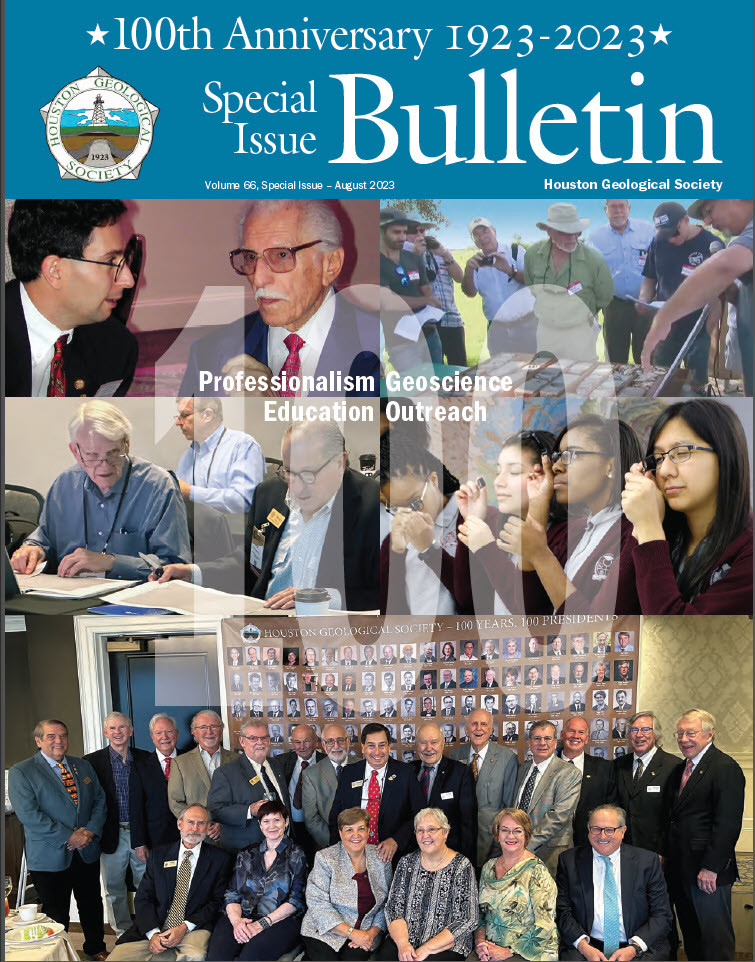
For a century, the Houston Geological Society has been the professional home of geoscientists who found, developed, and managed some of the world's most important energy resources, and the HGS Bulletin has carried the Society's voice throughout. With this September–October 2026 issue, the Bulletin begins a new chapter as a technically grounded, peer-reviewed publication that keeps the collegial spirit that has always defined HGS.
This is a humble beginning, and I don't expect immediate traction. But the changes introduced here are fundamental, organizational, and strategic. They are needed if the Bulletin is to be seen as a place where Houston's geoscience community publishes serious work, not just a place to learn what is happening next Tuesday.
I envisage four changes…
• A bi-monthly Bulletin with an Editorial Committee. The Bulletin will now publish five to six issues a year. This gives authors, reviewers, and editors the time that technical rigor requires. The new Editorial Committee is responsible for timely processing of submissions, peer review, proofreading, and maintaining high standards. Every technical article here went through that process; I thank the committee members who made it possible.
• Dedicated sections. The Bulletin now has sections for North America; the Gulf Coast, including the Gulf of Mexico; International; Technology; Energy, Environment, Public Policy; and a Student Section. The Student Section is reserved for graduate students, providing early-career geoscientists a real publication venue and motivating them to publish. Not every section will appear in every issue, but the structure gives readers a reliable map and authors a clear home for their work.
• All HGS media under one roof. The Bulletin, website, Newsletter, and social media are now coordinated, with roles redefined. Time-sensitive activities, such as dinner and luncheon meetings, courses, and registration deadlines, will be announced through Newsletter, website, and social media, which reach members faster, more often, and with reminders. That frees the Bulletin to publish durable technical content worth reading, citing, and keeping. It will also serve as the Society's chronicle. The Bulletin also offers space for authors and readers to continue the dialogue, and that feedback will help improve our articles.
• Financial viability. The Bulletin has operated at a loss for several years, and a publication that depends on subsidy cannot plan for the long term. The rebranding aims to build a Bulletin whose quality and readership attract advertisers, sponsors, and institutional supporters—in a way, build equity. Coordination with our digital channels should also reduce costs. This will take patience, and I invite members and corporate partners to help sustain it.
In this issue:
My modest target for this inaugural issue was four technical articles, and we just met it! Together they span exploration risk, subsurface imaging, carbon management, and emerging energy resources.
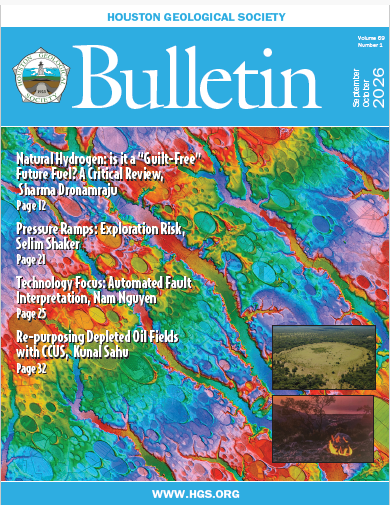
Featured Article: Geological Hydrogen: Guilt-Free Future Fuel. Natural hydrogen is being hailed as the next big thing after the shale revolution. In this critical review, I test the hype against reality. The "hydrogen system" differs from the petroleum system in three important ways. Its source is typically extra-basinal, ultramafic rocks rather than an organic-rich source rock. It can generate hydrogen and recharge traps instantaneously, on geological timescales, and because the hydrogen molecule is so small, seal quality is even more critical. Drawing on case studies from Mali, Kansas, France, Oman and the UAE, Brazil, Australia, and beyond, the article stresses that published volumes are resource estimates, not reserves. At roughly 0.4–1.5 kg CO₂e per kg of hydrogen, natural hydrogen is "low-guilt" rather than guilt-free. It will likely arrive too late to help meet the 2030–2035 Paris targets, but it could be a credible part of the 2040s energy mix and a second act for petroleum geoscience, one where the oil patch's century of knowledge gives us a real stake. I welcome a healthy debate in future issues.
Gulf Coast Section: Subsurface Pressure Ramps and Prospect Risk Assessment. Dr. Selim Shaker integrates log trends, seismic sequence stratigraphy, and pressure data within a four-zone framework. He shows that transgressive pressure ramps generally indicate competent seals, while regressive ramps may signal leakage or breach. His Gulf of Mexico case histories include the Princess and Cardamom fields and a plugged-and-abandoned well at Garden Banks 248. Together they make a persuasive case for placing pressure-ramp analysis at the center of prospect risk.
Technology Section: Automated Extraction of Fault Surfaces from 3D Fault Imaging Volumes. Nam Nguyen and Alejandro Jaramillo of Halliburton Landmark address a long-standing bottleneck: turning fault-likelihood and machine-learning fault-probability volumes into interpretable fault surfaces. Their three-step method derives fault samples, computes dip and azimuth, and links the samples through network analysis. It works with both deterministic and machine-learning inputs. Demonstrated on complex polygonal fault networks offshore Australia, the method is fast, parallelizable, and relevant to structural interpretation and drilling-hazard avoidance.
Student Section: An Integrated Static-to-Dynamic Workflow for Carbon Storage and CO₂-EOR in the Northern Gulf of Mexico. This article grew out of AAPG Imperial Barrel Award work by a graduate team from the Indian Institute of Technology Bombay: Kunal Sahu, Riya Tevatiya, Akash Kisore Kanojia, and Vaibhav Singh. I am happy to have mentored this team, which placed among the top three teams in Asia-Pacific, with no prior experience, and the article received the same review as every other submission. They built a complete workflow, from seismic interpretation through simulation, geomechanics, and economics, for a Lower–Middle Miocene field. Their results point to about 14.6 Mt of CO₂ storage in a saline aquifer, plus incremental oil and associated storage in an adjacent compartment, with favorable economics and manageable fault-reactivation risk.
2026 AAPG IBA Global Final. This is my 15th year, volunteering for IBA, judging and mentoring. IBA remains dedicated to giving students meaningful, real‑world exposure and ensuring the next generation of geoscientists enter the industry informed, inspired, and ready to contribute. I would strongly encourage Houston Geoscience Community to get involved. Catherine Donohue reports, the IBA global final returned in person to Houston on August 17, hosted by Murphy Oil. Institut Teknologi Bandung (Indonesia), University of Louisiana at Lafayette, and Eötvös Loránd University (Hungary), are the top three finalists, with Sultan Qaboos University (Oman) earning an Honorable Mention.
Looking ahead…
The first issue is always tough, with many unknowns. Launching a new structure, committee, and review process all at once took longer than expected, and I thank our authors and reviewers for their patience. The bi-monthly schedule gives future issues time for careful review and proofreading. My intention is to publish each issue during the first week of its opening month.
I am optimistic. Houston remains one of the world's great concentrations of geoscience talent, working across exploration, carbon storage, geothermal, hydrogen, critical minerals, data science, and public policy, and this August's IBA finalists showed that the next generation is ready. A peer-reviewed Bulletin that reflects that breadth can serve HGS for its next hundred years as well as it served the first.
That depends on authors, reviewers, sponsors, and engaged readers. Submit a manuscript to any of our sections. Volunteer to review. Encourage a graduate student to write for the Student Section. Tell us what you want to read. If your company values what HGS stands for, please help us put the Bulletin on sound financial footing.
This issue is a first step. With your support, the next ones will go further.
Sharma Dronamraju
Editor, HGS Bulletin